


The Ancient Mythology of Japanese Cuisine
Joely Thompson (Ishikawa)
Here are two truths and a lie about Japanese dining:
- You must say ittadakimasu before eating and gochisosama afterwards.
- You must finish all the food on your plate.
- You must not put chopsticks upright in your rice.
A little trick because in fact they’re all true… kind of. There are no laws stipulating you must follow these rules. But they fall under the broader category of 礼儀 作法 (reigi sahou). 礼儀 and 作法 are etiquette rules to follow in social settings. They are cultural practices, passed down by the generations, and followed out of respect. Children are taught these rules (and the reasons for following them) from a young age. For example, Japanese children are often told the folktale that each grain of rice contains seven gods, to ensure they finish their rice.
In fact, mythology and storytelling often play a role in these cultural practices. Japanese mythology contains many stories and deities which not only entertain, but also shape various practices such as culinary traditions, food preparation, and table manners. Therefore, examining how these ancient stories have left their mark on some of Japan’s most famous food provides greater insight into the reasons behind the practices.
Japanese dining experiences are renowned for offering simple, delicious food, high quality service, and careful preparation. However, much less is known about the mythology which underlies so many of the practices making Japanese dining so delightful.
It’s raining rice!
Rice remains a vital part of Japanese food and agriculture. It is a staple dish in most Japanese homes. However, rice cultivation dates back 10,000 years. The mythology associated with rice can be found in Japan’s oldest historical texts, the Kojiki (written in 712CE) and the Nihon Shoki (written in 720CE). These are both ancient texts depicting the birth of Japan and the Japanese deities. They offer insight into Japan’s cultural and spiritual history.
According to the Kojiki, rice has divine origins. The sun goddess, Amaterasu Omikami, first cultivated rice in the heavens. She gave this rice to her grandson, Ninigi no Mikoto, to take with him when he descended from the heavens as a gift to earth. This symbolised the beginning of agriculture. This myth highlights that rice is a sacred gift bestowed by the gods. Festivals are held every year celebrating rice cultivation, the most famous of which is the Inaho Matsuri (Rice Planting Festival), honoring Amaterasu for her blessings.
In the Nihon-Shoki, the most famous deity relating to rice is Inari, the god of rice and agriculture. Inari is one of the most celebrated deities in Japanese mythology; over 30,000 shrines are devoted to her. The most famous is the Fushimi Inari Taisha shrine in Kyoto. Inari is said to descend from the mountains every spring during rice planting season, to protect the rice, and ascend once the harvest is over. Farmers pray for a bountiful harvest at Inari shrines and Inari is also symbolised in inarizushi (rice wrapped in sweetened tofu).
Sake as a solution
Sake, a symbol of Japan as iconic as rice itself, has a similarly interesting mythology. In the Kojiki, sake appears as a solution. When mold started to grow on the rice which Amaterasu sent, the deities demonstrated how to brew alcohol with it. The people are indebted to the gods for showing them how to prevent rice waste, therefore, drinking sake is a way to connect with the deities.
Another legend in the Kojiki is of the monster Yamata-no-Orochi. The Shinto god Susano-o was visiting Izumo (modern day Shimane prefecture) when he discovered an eight-headed serpent demanding young girls be sacrificed every year. Susano-o offered the serpent sake, then slayed it after it had fallen into a drunken slumber.
Although sake is widely consumed in secular settings today, its legacy is rooted in Japanese culture and mythology. Sake is often still present at ceremonies including birthdays, funerals, and personal milestones as a mode of connection to the gods.
Stop stealing my. . . sushi?
As with rice and sake, the history of sushi is also ringed by storytelling. However, the legend of sushi’s origin does not come from the Kojiki or the Nihon-Shoki. Despite sushi being considered the national dish of Japan by many, there is no mention of sushi in either text. In fact sushi (in its earliest form), didn’t make it to Japan until between the 4th and 8th century.
Nevertheless, sushi has its own legend, the origins of which are unknown or thought to be an ancient Japanese wife’s account. An elderly woman, fearing thieves would steal her pots of rice, started hiding them in osprey nests. After some time, she returned to her pots to find the rice had fermented and fish from the osprey’s meal had mixed in with the rice, creating a delicious meal that also produced a new way of preserving fish.
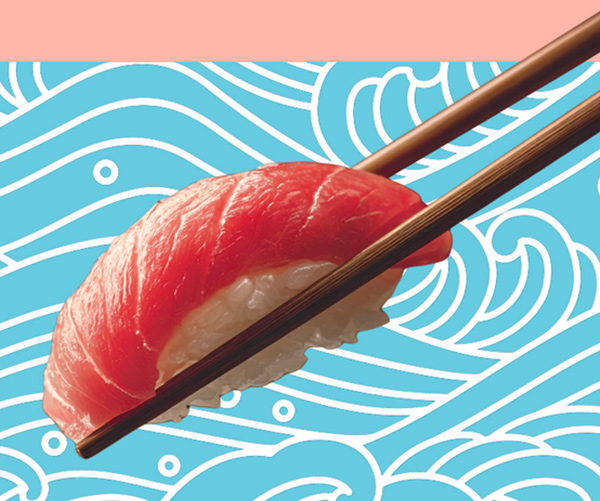
The actual history of sushi starts with an early form of fish preservation in which the fish is gutted and stuffed with rice (called narezushi in Japan). Narezushi originated in areas around the Mekong River. It was introduced to Japan by China through maritime trade routes between the 4th and 8th century. However, it wasn’t until the 19th century that sushi was revolutionized into a form that we would recognize as sushi today. A food vendor named Hanaya Yohei, was tired of waiting months for fermentation. He served fresh fish on top of vinegared rice with wasabi (called nigirizushi).
Although sushi has no divine origin, it is a symbol of Japanese identity, representing the nation’s agricultural heritage and connection to the sea.[[pull-quote]] Furthermore, the preparation and presentation is rooted in tradition. The itamae (sushi chef) trains for years, mastering basic skills before they are allowed to handle the fish. Also, they must select the freshest ingredients and pay high attention to detail when cutting the fish. This meticulousness is a reflection of broader Japanese values of respect for nature, harmony, and the pursuit of perfection.
Conclusion
For many, the mythological origins of their food and drink might be unimportant. Maybe, if you grow up saying ‘ittadakimasu’ and drinking sake at special events, you don’t question why. For others, perhaps praying to Inari every year is necessary to ensure an annual healthy harvest and pay respect to the deities. Either way, these practices are woven into culture. For individuals who have not grown up with Japanese cuisine, they’re interesting to explore, to understand how they impact Japanese cuisine and dining today.
Author Bio:
Joely Thompson is a first-year JET who enjoys writing, reading, and exploring Japan.