




This article is part of a web-original series
Marco Cian (Hyogo)
The 14 episodes of varying length that make up Bubblegum Crisis, AD Police Files, and Bubblegum Crash all make a piecemeal, but surprisingly cohesive, whole. It’s something of a miracle that they work together as well as they do, but thanks to fan demand the BGC story managed to keep at a steady pace before finally reaching a satisfying conclusion.
However, given said piecemeal, patchwork nature of the production just making things up as they went along, it’s no surprise that they would eventually try for a full reboot. Having a chance to do the whole thing over again but with a full plan from the start makes sense. But there’s more to it than just that.
Now, I have no evidence for this. Production and behind-the-scenes info on this remake in English is scarce. And yet, I cannot help but shake the feeling that Neon Genesis Evangelion was a key deciding factor in Bubblegum Crisis Tokyo 2040 taking on the form it did. First of all, it proved that 26-episode anime could work on tv without being tie-in fiction or an adaptation of other works. But as for the other reasons… well, we’ll get to that when we get to that.

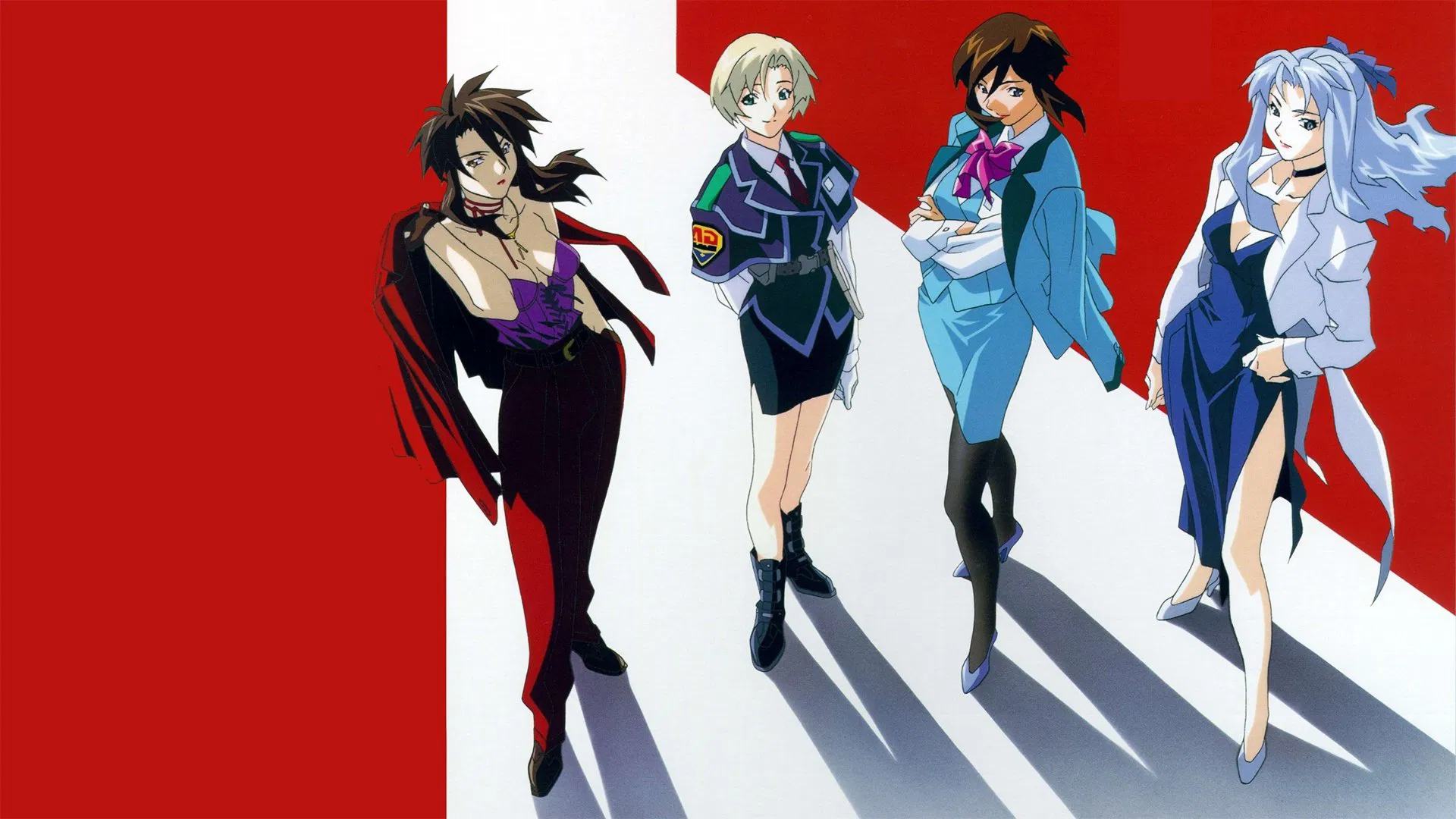
Bubblegum Crisis Tokyo 2040
The year is 2040. The place is Tokyo. And our heroine is a young woman named Linna Yamazaki. She’s come to the big, bad city to find work among the many megacorporations that fill Tokyo’s offices, the biggest and most powerful of which is GENOM. GENOM is a massive zaibatsu with its fingers in many pies, but its biggest and most important industry is the boomer, an autonomous robot that is used in just about every job no human wants to do.
Yet all is not well in paradise. Recently boomers have started to go rogue and berserk. And while the ADvanced Police has done its best to curtail this new threat, they are little match for the Knight Sabers, a gang of superheroines who fight and destroy boomer threats. The general public regards the Knight Sabers mostly with disinterest or disbelief, but not Linna.
You see, Linna didn’t just come to Tokyo to find work. She came to find these Knight Sabers and join them in their quest for justice. And after proving herself in battle, Linna manages to do just that. But as she fights alongside her teammates, dark secrets from Tokyo’s past are slowly uncovered, secrets that threaten to destroy not only Tokyo, but the whole human race.
Quick aside, before we get to the meat of this review, but this series finally answers why the robots are called boomers! It’s an acronym, see? It stands for
VOodoo Organic Metal Extention Resource
Ah, Engrish.
Anyways, onto serious matters. This show is just about everything I could hope for in a remake. The characters and world are all different while remaining somewhat familiar. You’ll recognize all the old Knight Sabers in this new batch, but the new team is just different enough that you can still be surprised by them. There are still plenty of allusions and references to the original series, but the show never feels like key-jangling or pandering. Even when something familiar appears, it’s different enough to not make the original redundant.
Something I mentioned in my review of the original series is how, despite trying to be a gritty cyberpunk, it was always kind of bad when it tried to be sad or serious, while being at its best when it was bright and cheerful.
You’d expect then for a remake that came out in the 90s to be even grittier and grungier, especially since Japan’s own bubble economy had burst between the releases of both shows. I often hear modern folks talk about 1991 in Japan as a really bleak period, after all, akin to the 2008 financial crisis in America.
However, as someone who was alive in 1999 (when this came out), and whose father worked at one of the many Bubble Era Japanese plants that sprang up in the States, I can tell you that 1991 was not really that titanic of a shift in everyday business. Sure, the economy went off a cliff, but people by and large kept going about their day-to-day lives as usual, something demonstrated by the show in how office culture in the 90s wasn’t any different from the 80s. Even with the bubble bursting, the 90s in Japan was not so much the Great Depression as a more restrained, less excessive version of the 80s.
Similarly, Bubblegum Crisis Tokyo 2040 is able to shine where its predecessor floundered by showing subtlety and restraint. You won’t get the operatic bathos of scenes like Priss killing Sylvie or Sylia confronting Mason, but this actually means that when Tokyo 2040 wants to be sad or serious it works better. It shows how a little can go a long way. And the format of a 26-episode, planned tv series instead of a patchwork 14-episode OVA series allows the show to spend more time on our heroine’s ordinary, day-to-day lives. We get to see what living in this world is like for the average man and woman on the street, tarrying a bit to learn more about this world, just as Linna takes time to learn how to be a Knight Saber.
Now, once again, I have no evidence that Evangelion was a major influence on this reboot. And yet, I can’t help but notice just a few similarities between the two works. Just off the top of my head you’ve got
- A first episode where our unsure, newcomer protagonist has to learn to pilot a mobile suit of sorts to fight a monster
- Said mobile suit being secretly sentient to some degree and having a limited battery life installed to prevent it from going rogue
- Said mobile suit growing a mouth and teeth when it does go rogue
- A villain who decides to destroy and remake the world out of a sense of loneliness and isolation
- Homosexual yearning in the protagonist (which ends up not really going anywhere)
- A finale in which a giant woman, who is a semi-divine, half-human clone of the wife of the scientist whose actions kickstarted the whole plot, ascends to the heavens so that she can assimilate the souls of humanity into a big pool where we’ll all be free of sorrow and pain, but also lose our individuality
- The last shot of our protagonist being them on a beach in a post-apocalyptic world
- A future in which we’re still using floppy disks for everything (okay, that last one I’ll bet was unintentional)
Y’know. Just a few.
At least with Tokyo 2040, they had their plot-losing episodes near the end, instead of actually at the end. Indeed, without getting too far into spoilers, I feel like in some ways the ending here was the ending that Anno initially intended for Eva, which he never got to properly execute until the final Rebuild movie.
Maybe that’s why you’ve probably never heard of Tokyo 2040 though. Like I said in my review on the series, the ending of NGE was so infamous, it arguably led to the series becoming the franchise it is today. For Bubblegum Crisis though, this is sadly the high water mark of the whole franchise. There were other installments to the franchise after this, which we’ll cover later on this summer. But… well, let’s just say that maybe having a satisfying ending made it so that fans were too satisfied, and didn’t feel the need to demand more BGC after this.
I think this is a real shame, because while Bubblegum Crash felt like the perfect, cathartic conclusion to the original saga, with me feeling contented and satisfied as the heroines walked off together, Tokyo 2040 only left me wanting more. This world and these characters still have so much potential. They have enough depth to them that even after 26 episodes, I feel like I only scratched the surface, saw the tip of the iceberg.
It reminded me of a piece of advice I heard from George MacDonald in Phantastes, how the best art is always just a little bit sad. Not overwhelmingly so, but just enough for the spice of melancholy to enhance the flavor. There’s a melancholy air to things, even as our heroines achieve their happy ending, and I came to love these girls so much, I wanted to see more of them, even after their story ended.
So at the end of all this, I think I really loved it. It’s works like these that make me glad I try these big review series. Being forced to watch stuff I wouldn’t have normally checked out on my own forces me to see things that are truly beautiful, things I’m thankful I got to witness. Really and truly, of all the works I cover in this Cyberpunk Summer, this is the one I recommend most. Check it out.
So, now let’s start with…

Is this a Cyberpunk?
Cyberpunk is about the little people – Yes, I think so. This show, like Crash did, has the boomers as the little people, but unlike Crash, it asks us to fully sympathize with the boomers’ plight. Even as the first boomer Galatea decides to assimilate all of humanity, it’s made abundantly clear through the motif of Jewish golems that she’s mostly decided to do this through a desire to rebel against the slavery she was built for. Also, the show likes to focus on those who can walk in big people circles while not actually being big people themselves (again, like medieval Jews, whom you could say built golems to have their own slaves to look down on, just as the ones in this world who look down most on the boomers are ones who resent how they’re only in the middle of the ladder instead of at the top).
Cyberpunk is pessimistic – Afraid not. This show is all about hope and striving to do the right thing. It’s certainly got a cynicism to it (the boomers existing in this world stem from capitalistic exploitation of cutting-edge medical technology, bastardizing it to create a slave labor force), but it’s never bitter, only ever biting.
Cyberpunk isn’t about changing the world – Again, no. Unlike Sylia in the original series, who only wanted revenge for her father’s death, this Sylia wants to destroy all boomers. Even as the story progresses and we learn how boomers can be victims just as much as villains, it ends with a sort of Evangelion-esque apocalypse (somewhere between the apocalypse of Kaiba and Metropolis). Humanity’s fine for the most part, but the world has been permanently changed. Also, you can tell this is a distinctly 90s update on the BGC story, because there is… a conspiracy! And like a lot of conspiracist stories, this puts the blame of society’s ills not on systems, but on some shadowy men (and robots) behind the curtain, who, once they are defeated, will take all our problems with them to the grave.
Cyberpunk is set in today, turned up to 11 – Yepyep! And I love it for that. Man, it was so great seeing 90s Tokyo again. Gave me all warm fuzzy feelings.
Cyberpunk wants to look cool – Hell yeah. And again, it’s so late 90s, I love it.
I guess, of all the works I’m covering for AJET, this is the least cyberpunk, even if it’s far and away my favorite.